Lysozyme Specification Checklist for Food Preservation
Compare lysozyme specs for food preservation: activity, purity, pH, dosage, COA/TDS/SDS, pilot validation, cost-in-use, and supplier checks.
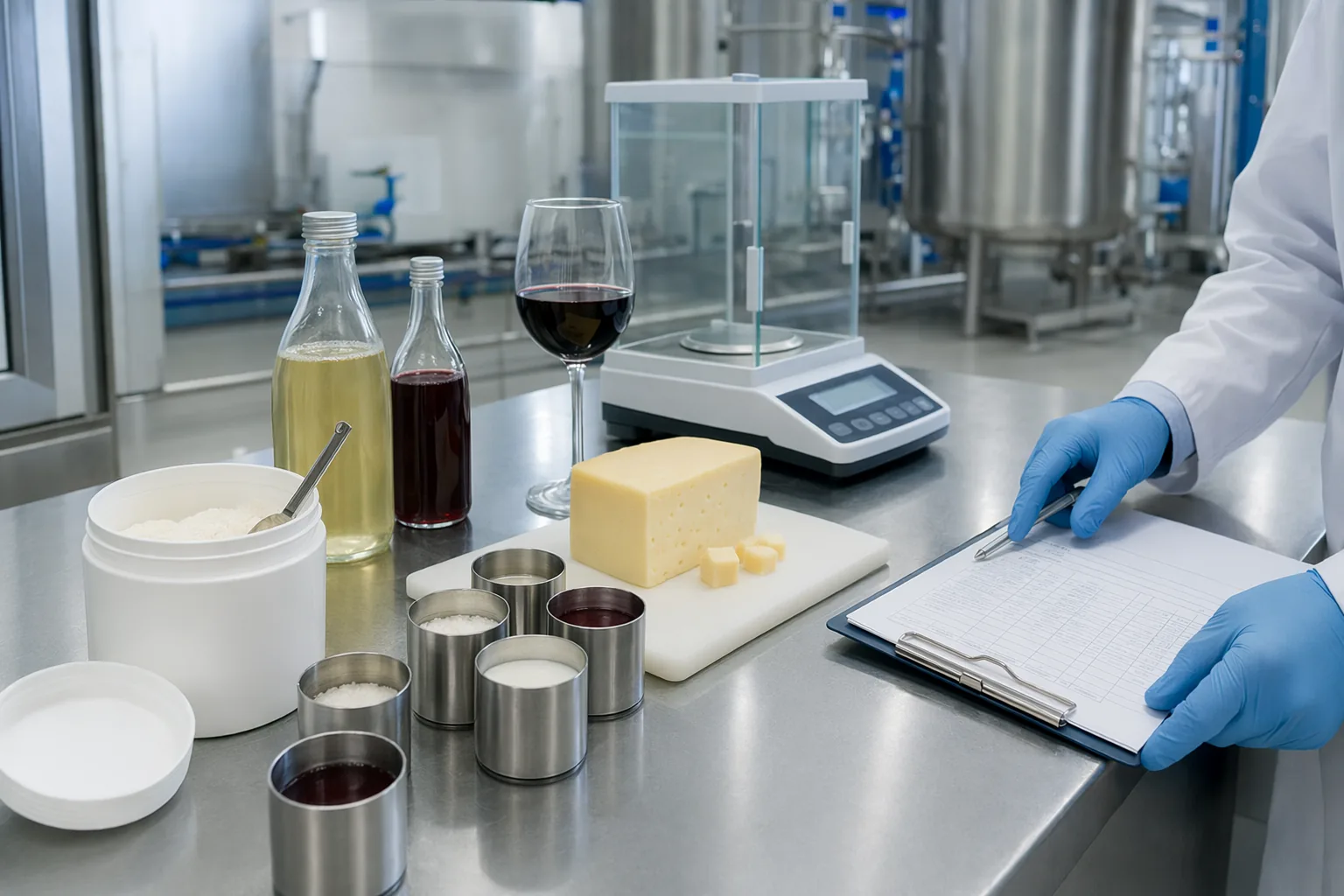
Compare industrial lysozyme options for food preservation using practical specifications, processing limits, documentation checks, and cost-in-use criteria before you approve a supplier.
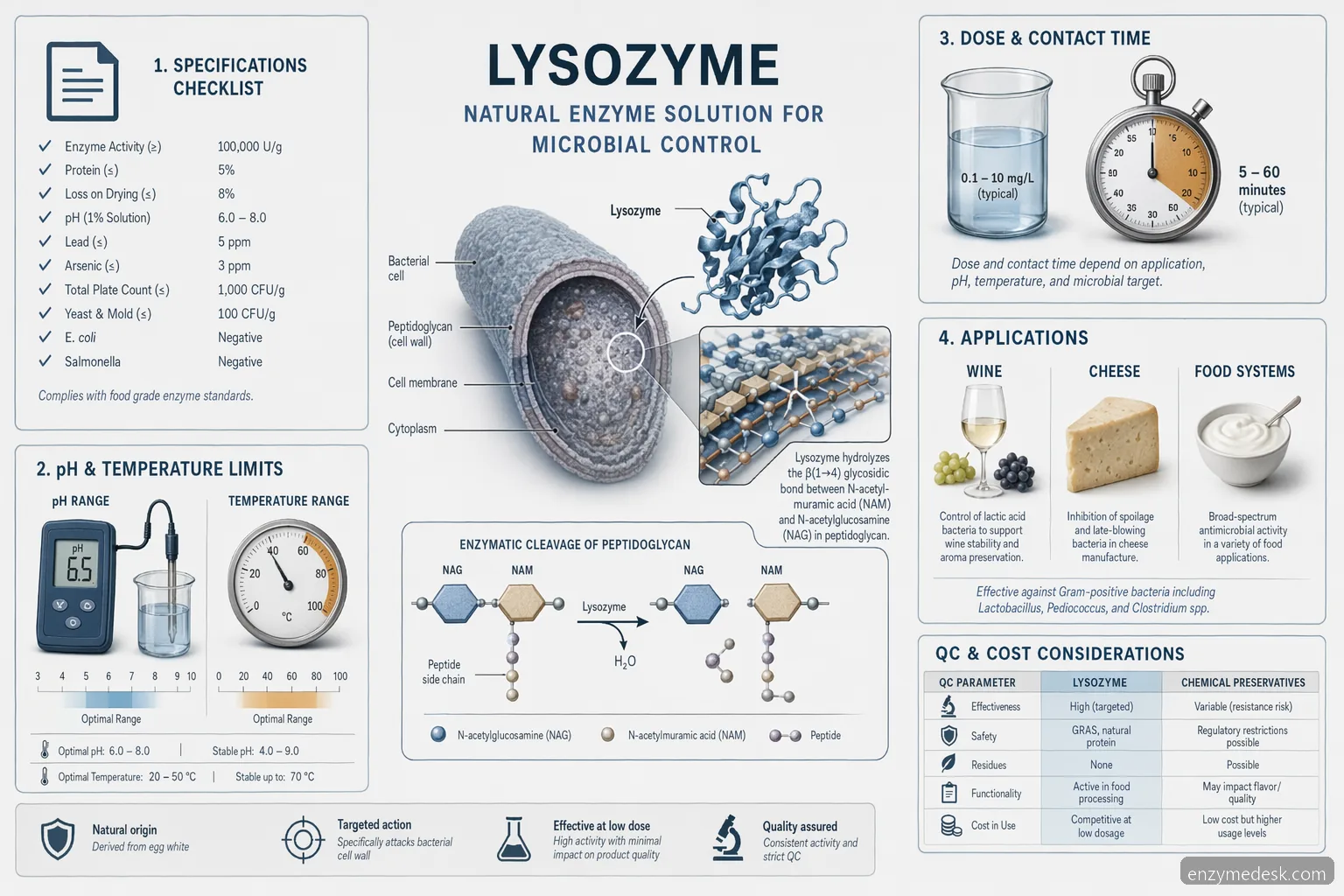
What is Lysozyme in Industrial Food Preservation?
Lysozyme is a naturally occurring antimicrobial enzyme used by food manufacturers to help control susceptible Gram-positive bacteria in selected food and beverage processes. In B2B purchasing, the key question is not simply what is lysozyme, but whether a specific lysozyme enzyme grade performs consistently in your matrix, at your process pH, salt level, temperature profile, and required shelf life. Commercial food-grade material is commonly supplied as egg white lysozyme, also described in some markets as lysozyme d oeuf. It may be offered as powder, granulate, or liquid preparation, with activity and purity stated on technical documents. For food preservation, buyers typically compare it with heat treatment, organic acids, protective cultures, filtration, or packaging controls. The strongest purchasing case is built from pilot data, regulatory suitability, allergen management, and cost-in-use rather than broad antimicrobial claims.
Primary comparison point: performance in the finished product matrix. • Common source: hen egg white lysozyme protein. • Main B2B use: targeted preservation support, not a universal preservative.
Specification Criteria That Matter Most
A lysozyme specification should let your technical, procurement, QA, and regulatory teams compare suppliers on measurable criteria. Start with declared enzymatic activity and the test method used, because units may not be directly comparable unless the assay conditions are aligned. Review protein lysozyme content, moisture, ash, appearance, particle size, solubility, microbiological limits, heavy metals where relevant, and residual processing aids. For food preservation, also verify that the grade is intended for food use and supplied with appropriate batch traceability. A low-cost lysozyme protein with unclear assay basis, poor solubility, or inconsistent microbiology can create higher cost-in-use than a more expensive but better controlled grade. Require a recent COA for each lot, a TDS with application guidance, and an SDS for handling, storage, and worker safety assessment.
Compare activity using the same assay basis when possible. • Check solubility in your brine, wine, slurry, or process water. • Confirm microbiological limits match internal QA standards. • Do not approve material without lot-specific COA review.
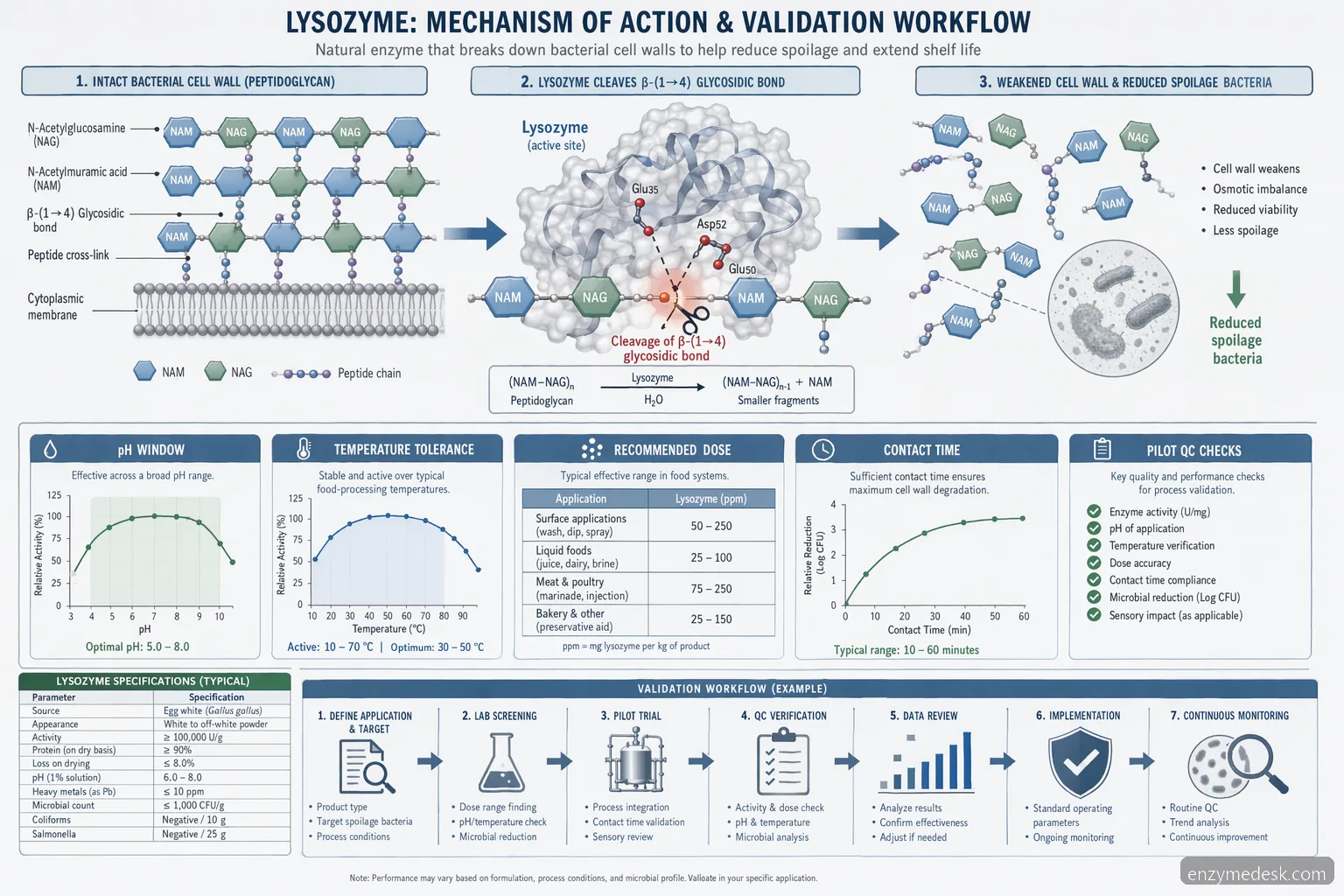
Process Conditions: pH, Temperature, Dose, and Contact Time
Lysozyme function depends strongly on the target organism and product environment. In many food and beverage systems, practical evaluation is often run in the approximate pH 3.0 to 7.0 range, with wine and acidic foods at the lower end and dairy matrices nearer the middle of that range. Activity may be reduced by excessive heat exposure, strong denaturants, or interactions with product components, so addition point matters. Trials commonly screen dose bands such as 50 to 500 mg/kg or mg/L, then narrow based on microbial challenge results, sensory impact, and cost. Some applications may use lower or higher levels depending on regulation and matrix effects. Validate contact time, mixing uniformity, filtration retention, and compatibility with salt, polyphenols, proteins, and stabilizers before locking the specification.
Typical screening pH: about 3.0 to 7.0, application dependent. • Common pilot dose screen: 50 to 500 mg/kg or mg/L. • Avoid high-heat addition points unless validated. • Confirm distribution through mixing and finished-product QC.
Comparing Lysozyme for Wine, Cheese, and Food Systems
Food preservation buyers often compare one lysozyme grade across wine, cheese, and other formulated foods, but performance cannot be assumed to transfer directly. In wine, pH, phenolics, sulfur dioxide program, turbidity, and filtration can influence practical results. In cheese, curd moisture, salt-in-moisture, starter culture balance, ripening temperature, and enzyme distribution are important. In prepared foods, thermal history, water activity, emulsifiers, gums, and protein binding may change apparent activity. Pharmaceutical or oral-care searches such as lysozyme 90mg, lysozyme chloride, or lysozyme mouthwash uk reflect different markets and should not be used to qualify food-processing material. For an industrial buyer, the relevant comparison is food-grade suitability, application evidence, lot consistency, documentation, and local compliance in the country of manufacture and sale.
Wine validation should include pH, turbidity, and filtration effects. • Cheese validation should include curd distribution and ripening conditions. • Retail or pharmaceutical pack descriptions are not food factory specifications.
QC Checks for Pilot Validation
Before moving from sample to supply agreement, run pilot validation under representative production conditions. Build a protocol that compares untreated control, current preservation method, and at least two lysozyme dose levels. Measure target microorganisms, total viable count where relevant, pH, water activity, salt, sensory attributes, color, turbidity, and shelf-life indicators. Confirm the enzyme is added at a point that provides enough contact time without unnecessary heat exposure. Include hold-time checks for prepared solutions, because hydration quality and microbial control in dosing tanks can affect consistency. QA should review whether the method introduces allergen labeling requirements, cleaning needs, or cross-contact controls. Procurement should receive pilot yield, waste, rework, and dosage data so the commercial comparison reflects true cost-in-use.
Use real plant water, ingredients, packaging, and storage conditions. • Compare against the current preservation baseline. • Record sensory and processing effects, not only microbial counts. • Include allergen and cleaning validation in the approval package.
Supplier Qualification and Cost-in-Use Comparison
A qualified lysozyme supplier should provide stable quality, responsive technical support, and transparent documentation. Request COA, TDS, SDS, allergen statement, country of origin, manufacturing flow summary where available, shelf-life and storage guidance, and change-control expectations. Ask how activity is standardized, how deviations are handled, and whether retain samples are kept. For cost-in-use, compare delivered price, activity-adjusted dose, preparation losses, labor, QC testing, shelf-life benefit, rejected batches avoided, and inventory risk. A supplier with stronger documentation and reliable lead times may be lower cost overall than a nominally cheaper offer. For larger plants, consider dual qualification after pilot confirmation to reduce continuity risk, but avoid approving alternatives unless they pass the same matrix-specific process validation.
Calculate cost per treated tonne, not only cost per kilogram. • Include activity adjustment and handling losses. • Review lead time, minimum order quantity, and change notification. • Qualify alternates with the same pilot protocol.
Technical Buying Checklist
Buyer Questions
Lysozyme is used as a targeted antimicrobial enzyme in selected food and beverage applications where susceptible bacteria are a concern. It is not a universal preservative and should be validated against the organisms and product matrix of interest. Industrial buyers should assess activity, source, dosage, process conditions, labeling impact, and regulatory suitability before adding lysozyme to a preservation program.
Compare suppliers using activity basis, assay method, food-grade suitability, lot consistency, solubility, microbiological quality, allergen documentation, and technical support. Request COA, TDS, SDS, traceability, shelf-life, and storage data before pilot trials. The best commercial choice is usually the material that delivers reliable performance at the lowest validated cost-in-use, not simply the lowest purchase price.
A practical first screen for many food preservation trials is often 50 to 500 mg/kg or mg/L, depending on product, target organism, regulation, and process conditions. This range is not a universal recommendation. Trials should include untreated and current-process controls, microbial challenge or shelf-life data, sensory review, and confirmation that the chosen dose is legal and label-compatible in the sales market.
No. Lysozyme function depends on pH, temperature exposure, salt, product composition, target organism, and contact time. Many food evaluations examine conditions around pH 3.0 to 7.0, but the effective window is application specific. High heat, binding to product components, or poor mixing can reduce practical performance. Validate activity retention and microbial outcomes under actual processing and storage conditions.
Searches such as lysozyme 90mg, lysozyme chloride, or lysozyme mouthwash uk usually relate to retail, oral-care, or pharmaceutical contexts. They are not appropriate specifications for industrial food preservation purchasing. Food factories should qualify food-grade lysozyme with supplier documentation, batch traceability, allergen statements, process validation, and application-specific QC results before commercial use.
Lysozyme for Research & Industry
Need Lysozyme for your lab or production process?
ISO 9001 certified · Food-grade & research-grade · Ships to 80+ countries
Frequently Asked Questions
What is lysozyme used for in food preservation?
Lysozyme is used as a targeted antimicrobial enzyme in selected food and beverage applications where susceptible bacteria are a concern. It is not a universal preservative and should be validated against the organisms and product matrix of interest. Industrial buyers should assess activity, source, dosage, process conditions, labeling impact, and regulatory suitability before adding lysozyme to a preservation program.
How should buyers compare egg white lysozyme suppliers?
Compare suppliers using activity basis, assay method, food-grade suitability, lot consistency, solubility, microbiological quality, allergen documentation, and technical support. Request COA, TDS, SDS, traceability, shelf-life, and storage data before pilot trials. The best commercial choice is usually the material that delivers reliable performance at the lowest validated cost-in-use, not simply the lowest purchase price.
What dosage range should be tested during pilot trials?
A practical first screen for many food preservation trials is often 50 to 500 mg/kg or mg/L, depending on product, target organism, regulation, and process conditions. This range is not a universal recommendation. Trials should include untreated and current-process controls, microbial challenge or shelf-life data, sensory review, and confirmation that the chosen dose is legal and label-compatible in the sales market.
Does lysozyme work at all pH and temperature conditions?
No. Lysozyme function depends on pH, temperature exposure, salt, product composition, target organism, and contact time. Many food evaluations examine conditions around pH 3.0 to 7.0, but the effective window is application specific. High heat, binding to product components, or poor mixing can reduce practical performance. Validate activity retention and microbial outcomes under actual processing and storage conditions.
Are lysozyme 90mg or mouthwash products relevant for food factories?
Searches such as lysozyme 90mg, lysozyme chloride, or lysozyme mouthwash uk usually relate to retail, oral-care, or pharmaceutical contexts. They are not appropriate specifications for industrial food preservation purchasing. Food factories should qualify food-grade lysozyme with supplier documentation, batch traceability, allergen statements, process validation, and application-specific QC results before commercial use.
Related: Lysozyme for antimicrobial control in food systems
Turn This Guide Into a Supplier Brief Request a lysozyme specification review, sample plan, and cost-in-use comparison for your food preservation process. See our application page for Lysozyme for antimicrobial control in food systems at /applications/lysozyme-definition-applications/ for specs, MOQ, and a free 50 g sample.
Contact Us to Contribute